

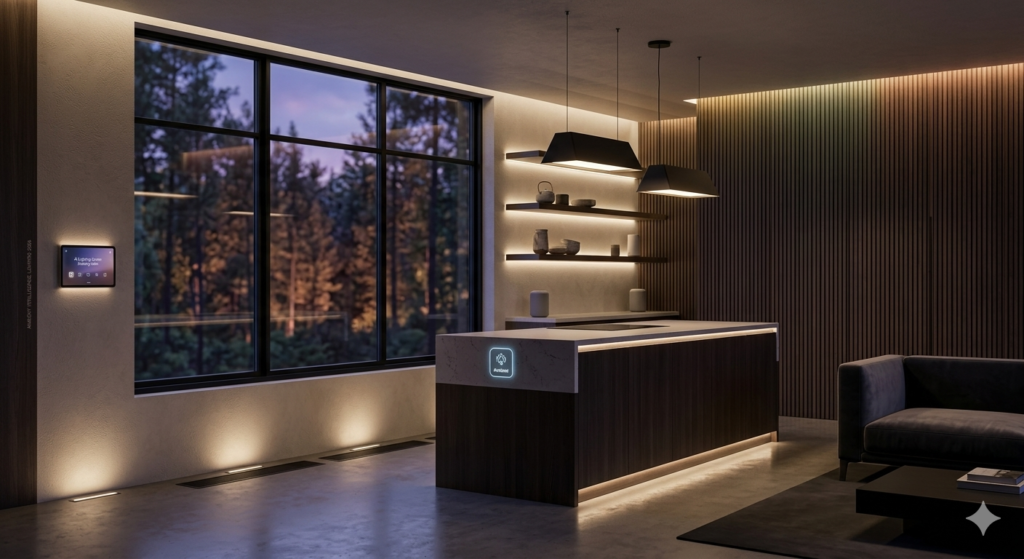
The year is 2026, and the symphony of our smart homes has evolved far beyond the discordant notes of mere automation. Remember the nascent days of “Hey Siri, turn on the living room lights” or the novelty of color-changing bulbs controlled by a clunky app? Those were the pioneering, albeit rudimentary, steps of smart lighting. Today, we stand at the precipice of a profound transformation, moving past simple commands into an era where our lighting doesn’t just respond; it anticipates. Welcome to the age of Ambient Intelligence, where your home’s illumination isn’t just about visibility; it’s about intuition, well-being, and a deeply personalized living experience.
Ambient Intelligence in lighting is the sophisticated culmination of advanced sensors, artificial intelligence, and seamless connectivity, all working in concert to create environments that understand and adapt to your needs without explicit instruction. Imagine lighting that subtly shifts to energize your morning, gently guides you through your day, and serenely prepares you for sleep, all while optimizing comfort, mood, and energy efficiency. This isn’t just smart; it’s prescient. It’s lighting that knows what you need before you even realize you need it, weaving itself into the very fabric of your daily life with unparalleled grace and intelligence.
The Rhythm of Life: Circadian Lighting Tech in 2026
In 2026, the concept of lighting that supports human well-being has transcended niche luxury to become an expected cornerstone of modern home design. At the heart of this evolution is advanced circadian lighting technology, meticulously engineered to mimic the natural progression of the sun throughout the day, directly impacting our sleep-wake cycles, mood, and cognitive performance.
The scientific foundation for this lies in the measurement of color temperature, expressed in Kelvin (K). Cooler, bluer light (5000K-6500K) is reminiscent of midday sun, boosting alertness and concentration by suppressing melatonin production. Warmer, amber light (2200K-3000K) replicates the hues of a sunset or candlelight, signaling to our bodies that it’s time to wind down and encouraging melatonin release for restful sleep.
The breakthroughs in 2026 are not just in the capability of bulbs to change color temperature, but in the seamless, automated intelligence behind it. Current-generation systems integrate with local weather data, your personal calendar, and even your biometric wearables to create a truly adaptive light environment.
How 2026 Systems Elevate Circadian Lighting:
Hyper-Adaptive Algorithms: Beyond simple sunrise/sunset schedules, these systems learn your unique chronotype—whether you’re a morning lark or a night owl—and adjust light exposure accordingly. If you wake up earlier for a flight, the lights can subtly shift to a more energizing spectrum to help you adapt.
Personalized Light Recipes: Advanced AI develops personalized “light recipes” based on your activities. For instance:
Morning Wake-Up: A gentle, low-intensity warm glow (2700K) gradually brightens and cools (to 4000K-5000K) over 30 minutes, simulating a natural dawn to ease you awake.
Focus Mode: While you work from your home office, lighting might settle into a cool, bright 6000K to maximize alertness and reduce eye strain, perhaps with subtle intensity adjustments based on the natural light entering the room.
Relaxation Evening: As evening approaches, the system autonomously transitions to warmer, dimmer tones (2500K-3000K), signaling the body to produce melatonin and prepare for sleep.
Integration with Wellness Ecosystems: Your smart lighting system in 2026 is no longer an island. It communicates with your smart bed (detecting sleep stages), your air purifier (monitoring air quality), and even your smart diffuser (releasing calming scents), creating a holistic environment for optimal well-being.
Dynamic Zonal Control: Different areas of your home can have distinct circadian profiles. Your kitchen might remain brighter and cooler for cooking, while your adjacent living room shifts to a warmer, more intimate setting for relaxation, all managed by the central AI.
The result is an environment that subtly, yet profoundly, supports your natural rhythms, fostering better sleep, heightened focus, and an overall improved sense of well-being, proving that the most impactful technology is often the one you barely notice working.
The Sixth Sense: AI-Driven Automation and Predictive Capabilities
The evolution of smart lighting from reactive to proactive is largely powered by a quantum leap in AI-driven automation. In 2026, sensors are no longer just rudimentary motion detectors; they are the “eyes” and “ears” of your home, capable of discerning nuanced environmental cues and even anticipating your needs.
Beyond Basic Presence Detection:
Occupancy and Activity Sensing: While previous generations could detect mere motion, 2026 sensors are far more sophisticated. Utilizing radar, thermal imaging, and even passive acoustic analysis, they can differentiate between a pet scurrying across the floor and a human entering a room. More impressively, they can infer activity—are you reading, cooking, watching TV, or simply relaxing? This allows for contextual lighting adjustments. If you’re reading, a focused task light might illuminate your area; if you’re watching a movie, the ambient lighting might dim to a cinematic glow.
Mood and Biometric Inference: This is where Ambient Intelligence truly shines. While still in sensitive development, research in 2026 is seeing early adoption of systems that can infer mood based on subtle environmental factors and user interactions. For example, if connected to a smart thermostat showing unusual temperature fluctuations combined with biometric data from a wearable indicating elevated heart rate, the system might interpret stress and subtly shift to calming, warm, low-intensity light, perhaps paired with soothing sounds. It’s not about mind-reading, but about pattern recognition and empathetic response based on comprehensive data integration.
Acoustic Signatures: Sensors can identify specific sounds—the doorbell ringing, a baby crying, the boiling of a kettle—and trigger corresponding light responses. A ringing doorbell might flash porch lights briefly, while a crying baby in the nursery could activate a gentle, warm nightlight to assist parents.
Seamless Interoperability with Matter:
The advent of Matter has been a game-changer, shattering the proprietary silos that once plagued the smart home ecosystem. In 2026, Matter provides the universal language for all smart devices, ensuring seamless integration and robust functionality across brands.
Unified Control: No more juggling multiple apps. Your AI-driven lighting system integrates effortlessly with your smart thermostat, security cameras, smart blinds, and entertainment systems, all communicating via Matter.
Enhanced Automation Scenarios: This interoperability unlocks truly complex and intelligent automation. Imagine this:
As you approach your home, your smart lock unlocks (Matter), your entry lights brighten to a welcoming tone (Matter), your thermostat adjusts to your preferred temperature (Matter), and your favorite playlist begins to play softly (Matter).
If a smoke detector (Matter) senses danger, not only does it alarm, but all lights automatically flash red and brighten to full intensity, and exit pathways are illuminated, guiding occupants to safety.
Local Processing & Resilience: Many advanced AI lighting systems now incorporate significant local processing capabilities. While cloud connectivity remains important for updates and complex learning, critical automations and everyday lighting adjustments can occur entirely on the local network, drastically reducing latency and ensuring functionality even if your internet connection goes down. This enhances reliability and responsiveness, making your home’s intelligence truly dependable.
These advancements in AI-driven automation and Matter integration are transforming smart lighting from a novelty into an invisible, indispensable butler, orchestrating a living environment that is intuitively responsive and remarkably intelligent.
The Art of Illumination: Decorative Smart Tech in 2026
In 2026, smart lighting has shed its utilitarian skin and emerged as a powerful medium for interior design and artistic expression. The “light fixture” as a singular, static object is giving way to dynamic, integrated light-emitting surfaces that blur the lines between technology, art, and architecture. This new generation of decorative smart tech is all about seamless integration, immersive experiences, and personalized aesthetics.
Key Innovations in Decorative Smart Lighting:
LED Wall Panels as Dynamic Art: Moving beyond simple backlighting, intelligent LED wall panels are now fully customizable canvases for light. These modular systems, often composed of high-density micro-LEDs, can:
Display Abstract Art: Generate mesmerizing, ever-changing patterns, colors, and gradients, transforming a plain wall into a living piece of digital art.
Simulate Nature: Recreate the serene sway of bamboo in a breeze, the gentle ripple of water, or the vibrant hues of a sunset, bringing elements of the natural world indoors.
Amplify Mood: Shift from vibrant, energetic displays for social gatherings to calm, minimalist gradients for relaxation, all at the touch of an app or in response to AI cues.
Provide Functional Light: Despite their decorative appeal, they can also emit bright, even general illumination when needed, seamlessly transitioning between ambiance and utility.
Transparent OLED Displays as Integrated Light Sources: This revolutionary technology allows for surfaces that are transparent when off, but become vibrant light sources or displays when activated.
Window Integration: Imagine a window that can display decorative patterns or dynamic light scenes at night, acting as both a privacy screen and an artistic light source, without obstructing your view during the day.
Furniture Surfaces: Coffee tables, room dividers, and even kitchen backsplashes can incorporate transparent OLEDs, becoming interactive light sources that can display information, create captivating visual effects, or simply provide ambient illumination that vanishes when not in use. This “hidden tech” approach ensures that advanced lighting only appears when needed, maintaining clean, minimalist aesthetics.
Architectural Elements: Glass railings, shower screens, or even portions of ceilings can become dynamic light-emitting surfaces, making light an integral, invisible part of the structure itself.
“Hidden” Tech and Invisible Integration: The ultimate sophistication in 2026’s smart lighting is its near-invisibility.
Recessed Micro-Linear Lighting: Ultra-thin LED strips and micro-linear fixtures are integrated into architectural details, ceiling coves, and cabinetry, providing exquisite ambient or task lighting without a visible fixture. The light appears to emanate from the structure itself.
Furniture-Integrated Luminaires: Light sources are built directly into furniture pieces – the underside of a bookshelf, the lip of a headboard, the leg of a desk – providing targeted illumination that feels organic and purposeful, removing clutter.
Material-Embedded Lighting: Advances in material science allow for light-emitting fibers and components to be woven directly into fabrics, wall coverings, and even poured concrete, creating diffuse, soft glows that are part of the material itself.
This seamless integration transforms lighting from a functional necessity into an immersive design element, enabling homes to dynamically change their entire aesthetic and atmosphere, reflecting mood, activity, and personal style with unprecedented fluidity and elegance.
Illuminating the Path to Sustainability: Energy Efficiency in 2026
The smart lighting of 2026 isn’t just about comfort and aesthetics; it’s a critical component in building a sustainable future. With rising energy costs and an increasing global awareness of environmental impact, these advanced systems are engineered to minimize electricity consumption and reduce the carbon footprint of the modern home, proving that cutting-edge technology can also be profoundly eco-conscious.
How Smart Lighting Drives Energy Savings:
Precision Dimming and Zonal Control:
Dynamic Dimming: The days of lights being either “on” or “off” are long gone. 2026 systems continuously adjust light intensity based on real-time needs. AI algorithms analyze ambient natural light levels, occupancy, activity, and even the time of day to ensure that only the precise amount of light required is being emitted. If a room has ample daylight, the artificial lights will dim or turn off completely, even if occupied.
Granular Zonal Control: Homes are divided into highly specific lighting zones. Instead of lighting an entire open-plan area, the system can illuminate just the kitchen island during meal prep, or a reading nook in the living room, ensuring energy is never wasted on unoccupied or unutilized spaces. This fine-tuned control dramatically reduces overall consumption.
Occupancy-Based Automation:
Advanced Presence Detection: As discussed, 2026 sensors accurately differentiate between human presence and pets, or even stationary individuals, ensuring lights only stay on when genuinely needed. If a room is empty for a predetermined period, the lights will gently fade out or switch off, instantly preventing unnecessary energy drain.
Predictive Scheduling: AI learns your routines over time. If you consistently leave for work at 8 AM, the system can begin to power down non-essential lights a few minutes beforehand, proactively saving energy.
Local Processing and Edge AI:
Reduced Cloud Reliance: While initial setup and complex learning might leverage cloud resources, the majority of day-to-day lighting decisions and automations in 2026 are processed locally on edge devices within your home. This significantly reduces the energy overhead associated with constant data transmission to and from remote servers.
Faster Response, Less Latency: Local processing means decisions are made almost instantaneously. Lights respond faster to presence or changes in natural light, ensuring optimal efficiency without noticeable delays, thereby preventing situations where lights remain on unnecessarily due to slow system response.
Long-Lasting LED Technology:
Inherent Efficiency: The core technology behind smart lighting—LEDs—is inherently more energy-efficient than traditional incandescent or fluorescent bulbs. They convert a higher percentage of energy into light rather than heat, requiring significantly less electricity.
Extended Lifespan: LEDs boast lifespans measured in tens of thousands of hours, reducing the need for frequent replacements. This not only saves consumers money but also minimizes manufacturing and disposal waste, contributing to a circular economy model.
By intelligently managing every lumen and every watt, the next generation of smart lighting is more than just a convenience; it’s a vital tool for homeowners committed to reducing their environmental footprint, proving that a brilliant future can also be a greener one.
The Vibe Architect: Why Lighting is Today’s Ultimate Smart Home Investment
In 2026, as our homes become increasingly intelligent, integrated, and intuitive, one element stands out as the most potent force in shaping our daily experience: lighting. Beyond its fundamental role in visibility, smart lighting has evolved into the ultimate “vibe” investment, the central orchestrator of atmosphere, mood, and well-being within the connected home.
Think about it: sound systems provide auditory ambiance, smart thermostats manage comfort, and integrated security offers peace of mind. But it is lighting that paints the canvas of your existence, subtly influencing your energy levels, your emotions, your focus, and even the quality of your sleep. It’s the invisible architect of your living narrative.
The advancements in circadian technology, AI-driven automation, and decorative integration mean that your lighting system is no longer just a collection of bulbs; it’s a dynamic, responsive entity that understands and enhances every moment. It’s the silent partner in your morning routine, the focused ally during your workday, the soothing presence in your evening, and the artistic flourish that transforms your space.
Investing in 2026’s ambiently intelligent lighting isn’t just about aesthetics; it’s about reclaiming your biological rhythm in an increasingly digital world. As these systems become the backbone of our daily environments, the home transcends being a mere shelter. It becomes a responsive, living entity that supports our mental health, productivity, and rest.
The Future is Bright (and Automatic)
We are standing at the threshold of a new era where technology finally fades into the background. Ambient intelligence means you stop managing your home and start living in it. When your lights can anticipate your needs—dimming as you relax, brightening as you work, and mimicking the morning sun to wake you gently—the traditional light switch becomes a relic of the past.
If you are looking to upgrade your living space this year, prioritize systems that offer deep integration and circadian support. The transition from “smart bulbs” to “intelligent ambiance” is the single most impactful change you can make for your 2026 home.