

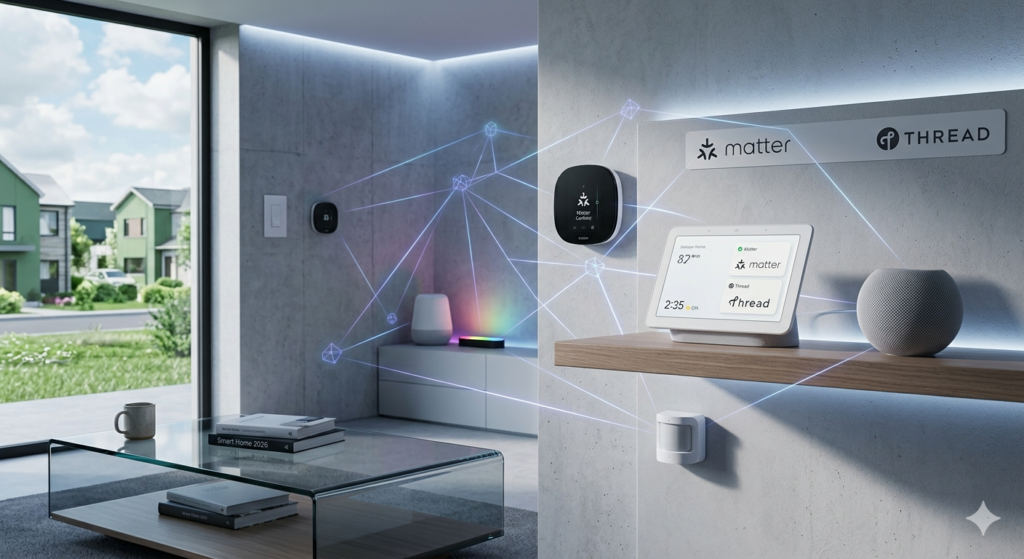
For years, the promise of a truly intelligent home felt like a fragmented dream, bogged down by a labyrinth of incompatible devices, disparate apps, and the constant frustration of a smart light failing to communicate with a smart switch from a different brand. We’ve all been there: juggling half a dozen apps to control different aspects of our homes, wondering why something as simple as turning on a light required a trip to the cloud and back. The smart home, for all its potential, often felt more chaotic than clever.
But as we look ahead to 2026, a seismic shift has occurred, one that’s finally delivering on that original promise of seamless integration. At the heart of this transformation are two intertwined protocols: Matter and Thread. Think of Matter as the long-awaited “universal language” that allows all your smart devices, regardless of manufacturer, to understand each other perfectly. And Thread? That’s the robust, dedicated “physical highway” facilitating these conversations, ensuring they happen instantly and reliably, right within your home. Together, they’re not just making your smart home smarter; they’re making it truly intelligent, responsive, and secure.
The Evolution of Matter: Speaking a Universal Tongue
When Matter, an open-source standard developed by the Connectivity Standards Alliance (CSA), first launched, it arrived with a flurry of anticipation, tempered by the inevitable growing pains of a revolutionary new technology. Initial iterations, while groundbreaking, faced challenges in broad device support and a truly seamless user experience across all platforms. However, the Matter of 2026, specifically through its mature 1.4 and 1.5 versions, represents a quantum leap in stability, interoperability, and functionality.
Today, Matter has successfully unified an unprecedented alliance of tech giants. Apple, Google, Samsung, Amazon, and hundreds of other device manufacturers are not just supporting Matter; they are actively integrating it as the bedrock of their smart home ecosystems. This unified front means a Matter-certified light bulb from Brand A will seamlessly integrate with a smart home controller from Brand B and a motion sensor from Brand C, all managed through your preferred smart home app, whether that’s Apple Home, Google Home, or Samsung SmartThings. The days of device lock-in and ecosystem walled gardens are, thankfully, drawing to a close.
One of Matter’s most transformative features is its inherent emphasis on local control. Unlike many legacy smart home systems that often routed every command and status update through cloud servers, Matter-enabled devices primarily communicate directly within your home network. This fundamental architectural shift delivers immediate and profound benefits. Commands execute with lightning speed because they don’t need to traverse the internet to a remote server and back. Your lights respond to a switch press or a sensor trigger instantaneously, eliminating the frustrating lag that plagued earlier setups. Furthermore, local control drastically improves reliability; your smart home continues to function even if your internet connection goes down, ensuring essential automations remain operational. This shift not only enhances user experience but also lays critical groundwork for improved privacy and security.
Deep Dive into Thread: The Resilient Network Highway
While Matter provides the universal language, it’s Thread that offers the dedicated, high-performance network layer for these conversations to take place. Imagine your home’s existing Wi-Fi network as a multi-lane superhighway, often congested with streaming video, online gaming, and dozens of personal devices. Now imagine a separate, dedicated express lane built exclusively for your smart home devices – that’s Thread.
Thread is a low-power, self-healing wireless mesh network protocol built for the Internet of Things (IoT). Let’s unpack what that means for your smart home:
Low-Power: This is crucial for battery-operated devices like door/window sensors, motion detectors, and smart buttons. Thread’s efficiency allows these devices to operate for months, even years, on a single coin cell battery, drastically reducing maintenance and battery waste. Traditional Wi-Fi, by contrast, is far too power-hungry for such applications, requiring constant recharging or direct power.
Self-Healing Mesh Network: Unlike traditional Wi-Fi networks where devices connect directly to a central router (a “star topology”), Thread creates a mesh. In a mesh network, every Thread device (especially those that are always powered, like smart plugs or light bulbs) can act as a repeater, extending the network’s range and strengthening its reliability. If one device goes offline or a connection path becomes obstructed, the network automatically and intelligently reroutes communications through other available devices. This “self-healing” capability means your smart home remains robust and responsive, even if a device is moved or temporarily loses power. The network intelligently adapts, ensuring commands always reach their destination.
IP-Based Foundation: A key technical advantage of Thread is that it’s built on Internet Protocol (IP). This means Thread devices communicate using the same fundamental language as the rest of the internet, making them inherently compatible and easily bridgeable with your home’s main network. This IP-based nature is precisely what makes Thread the perfect underlying transport layer for Matter, as Matter itself is designed to run over IP networks.
The linchpin connecting your Thread devices to your broader home network and the internet (when necessary) is the Thread Border Router. Unlike proprietary hubs required by older smart home protocols, Thread Border Routers are often integrated directly into existing smart home devices you might already own, such as an Apple HomePod Mini, certain Google Nest Hubs, or specific Amazon Echo devices. These devices serve a critical function: they translate Thread network traffic into Wi-Fi or Ethernet, effectively bridging the dedicated Thread mesh with your home’s wider IP network. This eliminates the need for yet another dedicated hub, streamlining your setup and leveraging hardware you likely already possess.
The technical implications are significant. The direct, local communication facilitated by Thread results in incredibly low latency. Latency refers to the delay between sending a command and receiving a response. With Thread, this delay is virtually imperceptible. When you trigger a motion sensor, the lights respond almost instantaneously. When you tap a smart switch, the associated fixture illuminates without a beat. This responsiveness is what truly makes a smart home feel smart and intuitive, transforming it from a novelty into a genuinely functional and reliable extension of your living space.
Enhanced Privacy and Security for US Households
Beyond speed and reliability, the Matter and Thread synergy brings substantial improvements to privacy and security, a paramount concern for many US households. The architecture prioritizes local control, which fundamentally reduces the risk of data exposure.
With Matter devices communicating over Thread, the vast majority of your day-to-day smart home interactions—like turning lights on and off, adjusting thermostats, or checking sensor statuses—stay entirely within your local network. This means critical commands and sensitive information don’t leave your home, removing the need to traverse external cloud servers owned by various manufacturers. Fewer external connections translate directly to fewer potential points of vulnerability and a significantly reduced attack surface.
Furthermore, Matter mandates robust end-to-end encryption for all communications between devices, ensuring that even if local network traffic were intercepted, it would be unreadable. Devices undergo stringent attestation and authentication processes during pairing, verifying their legitimacy and preventing unauthorized or rogue devices from joining your network.
While cloud services are still necessary for features like remote access when you’re away from home, voice assistant processing, or firmware updates, the default operating mode of a Matter-over-Thread system keeps your sensitive usage data private and within your control. This shift offers a new level of trust and confidence, empowering homeowners with greater autonomy over their personal data and providing a strong defense against potential cyber threats and privacy intrusions that have plagued cloud-dependent systems of the past. For consumers wary of their data being collected and monetized, this local-first approach is a game-changer. Beyond the technical resilience, the real victory of the Matter-over-Thread ecosystem is the peace of mind it offers. In a world where smart devices have often felt like “rental hardware” dependent on a manufacturer’s cloud stability, this shift grants true ownership back to the user. Your home continues to function even if your internet goes down or a company’s servers decide to take a nap.
The Verdict: How to Build Your 2026 Smart Home
As we navigate through 2026, the advice for tech enthusiasts and homeowners is simple: look for the logos. When purchasing new hardware, the presence of both the Matter and Thread badges is no longer a luxury—it’s a requirement for a future-proof setup.
Whether you are deep into the Apple Home ecosystem, a Google Nest aficionado, or a Samsung SmartThings power user, the walls have finally come down. We are no longer buying into a brand; we are buying into a unified, secure, and lightning-fast experience. The “Smart Home” has finally graduated from a hobbyist’s frustration to a seamless, invisible assistant.